
Rutgers University Extension
Stink bugs, oh, my! They are here in the Pacific Northwest and they can be very destructive to native and non-native plants in your yard, green house, garden and forest. How do you identify them, find them, destroy them – but, not destroy the native bugs?
Here is some helpful information about the invasive Brown Marmorated Stink Bugs (BMSB) we’ve gathered together for you.
The Washington State University (WSU) “Tree Fruit Research” group has some great info on the invasive “Marmorated Brown Stink Bug“. (This article had info from Rutger’s Extension, but, they’ve moved the links, so we’ve redone this post, plus updated the links, May 2025.)
WSU Link: https://tfrec.cahnrs.wsu.edu/beers-tfentomology/bmsb/
We do NOT recommend stepping or squishing the bugs, nor vacuuming them into your vacuum cleaner because, WELL, when they feel threatened, or are hurt, they release a pretty awful STINK. Your shoe or your vacuum cleaner will smell awful and you likely won’t be able to clean them thoroughly!
Winter/Spring can be a great time to destroy adult stink bugs and eggs.
We’ve seen several online posts of people discovering deposits of Stink Bug EGGS in tucked away places. Now can be a good time to properly identify the adults and destroy them. Remember, native “stink bugs” and non-native stink bugs can look like each other in early stages, so, if destroying eggs, make sure you know whose they are! The adults are much easier to accurately identify.
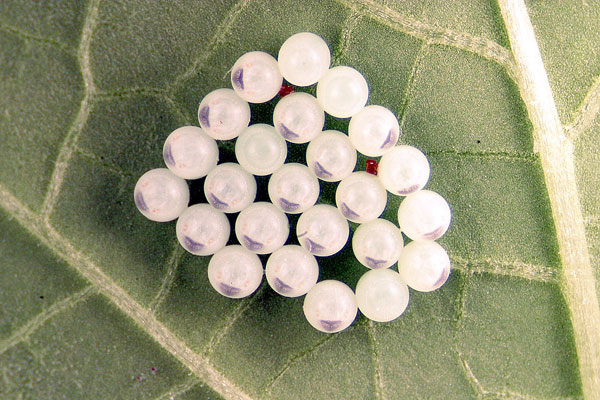
Rutgers Extension – Stink Bug eggs
Stink Bug Patrol.
Garden club members have spotted Brown Marmorated Stink Bugs on the move very early in the spring since 2016 through 2025. “It is not too early to start brown marmorated stink bug patrol” says S.G. ” I have found both live ones and dead ones – yeah! – in the house.” And M.T. says, “I found an adult stink bug on the plant in my kitchen window. I guess he’s been living there all winter. Time to check our houseplants.”
Three members have had good success with the simple method of a can of soapy water with a wide lid and a stick, spoon or long utensil to flick the bugs into the water where they drown. (Pour them into the toilet and flush.) Poor results were reported with the home-made large pop bottle with inverted top and light inside it by member M.N.
Stories from Members:
In November 2014, one of our members who initially reported finding Brown Marmorated Stink Bugs in her garden, destroyed all but one of them. The survivor is still alive after spending the last several months inside a plastic zip lock bag, in her fridge, so, they are tough!
Another member reported finding dozens of them between two storm windows at a local hotel in a south facing room during the recent sub-freezing weather; she flushed them down the commode.
Two of our garden members have discovered both the adult and nymph stages of the voracious and invasive “Brown Marmorated Stink Bugs” (BMSB), aka Halyomorpha halys, in their gardens. Now, these bugs are being seen all over Clark County, WA, as they seek places to over winter. Read on to determine if you have the non-native, invasive species (which you should kill) or the native species (which you should simply release back outside).
Stink Bug Nymphs look like Lady Bugs, but are not!
Don’t be fooled by the nymph stage into thinking they are baby Lady Bugs. They are not! (See eggs on leaf picture.)

Rutgers Extension – stinkbug eggs & babies
Lady bugs are much bigger than Stink bug nymphs. Stink bug nymphs are more “tick” size. And Lady bug nymphs look more like little crocodiles than tiny Lady Bugs.
Adult “Brown Marmorated Stink Bugs” (BMSB) can make an awful smell if you disturb or smash them (thus the name). DO NOT VACUUM them – your vacuum will SMELL for pretty-much forever.
HOW TO IDENTIFY ADULTS:
Is it a native “good” stink bug, or a non-native “bad” stink bug? Examine the pictures carefully.
Here are some distinguishing features that can help you out, a photo, and web site with even more detailed identification tips:
- BMSB: Grey underbelly. Natives (good bugs) usually have yellowish underbelly.
- BMSB: Antennae alternate white and dark stripes. [Photo: Rutgers]
- BMSB: Black & white banding near back legs. [Photo: Rutgers]
Kill with extreme prejudice – but make sure you know what it is first!
Brown Marmorated Stink Bug – BAD – KILL!
More identification info at the WSU extension web site [1]:
https://tfrec.cahnrs.wsu.edu/beers-tfentomology/bmsb/Thanks to L.M., S.L., K.D., M.N., M.T., Penn State, Rutgers Extension for photos and WSU extension for updated information, warning and identification!
Below is a picture of a GOOD native “stink bug”, known as the “Western Conifer Seed Bug”, aka Leptoglossus occidentalis. This is one you should just put outside of your house and let alone.
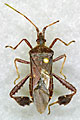
Native Bug – Good – DON’T kill!
Pictures of Stink Bug Damage:
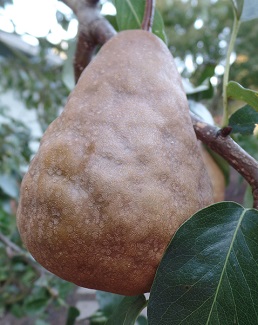
N.B. pear
Jan2015: Here is a pix of damage done to N.B. Garden Club member’s bosc pears. “Stink bugs bit into the pears. Their bite leaves a small amount of saliva in the pear that penetrates the pear’s white meat. This leaves a ripple effect on the pear skin. ” One of her friends noticed a similar look on some apples for sale and notified the shop. Upon cutting open the pears,”they could see the saliva damage to the meat.” [2]
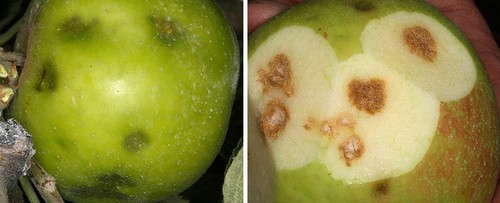
Penn State – stink bug apple damage
Here are additional pix of apples damaged by stink bug bites, from Penn State Entomology department web site. [3]
Lastly, according to George Hamilton, “pest management expert and professor of entomology at Rutger’s University”, as reported in USA Today by Janice Lloyd, the fruit or vegetable is often still safe to eat, simply cut out the “bad parts”. Of course, if there is too much damage, there may not be much left to cut out, or the fruit/vegetable may have suffered additional damaging invasion by other fungi or bacteria rendering it inedible. Lastly, people often don’t wish to buy or eat such damaged fruit.
“Do brown marmorated stink bugs have any natural enemies (predators and parasitoids) in the United States?
Because the Asian Brown Marmorated Stink Bugs were thought to have no natural enemies in the Americas (except maybe humans! 🙂 ) , research was taking place to determine if the native Asian wasp that preys on the Stink Bugs could be introduced. However, there was concern that the Asian wasp may do serious harm to other insects, and native American stink bugs, too, so, researchers are proceeding cautiously. [3]
UPDATE: Interestingly, in October 2015, the Columbian Newspaper (Vancouver, WA, USA) reported that the tiny wasp trissolcus japonicus, which is a natural predator of the Brown Marmorated Stink Bug in Asia, was found in Vancouver, WA. Probably arrived with the Stink Bugs at some point. Of course, one wonders, what NATIVE bugs will also fall prey to this introduced wasp predator? (Sigh.)
WSU has posted a video showing the parasitic wasp laying eggs in BMSB eggs and another video of the wasps hatching from inside the BMSB eggs. LINK: https://tfrec.cahnrs.wsu.edu/beers-tfentomology/bmsb/samurai-wasp/
It has been discovered that there are various native natural enemies that do feed on brown marmorated stink bugs including predatory stink bugs, assassin bugs, and two egg parasitoids. Unfortunately they attack many species of insects. Because of this they are unable to control the brown marmorated stink bug at this time.
References:
- WSU Extenstion: https://tfrec.cahnrs.wsu.edu/beers-tfentomology/bmsb/
- Garden Club member, N.B.
- Penn State Entomology department web site:
- Rutger’s New Jersey Agricultural Experimental Station – has great FAQs on BMSB: https://njaes.rutgers.edu/stink-bug/
- and https://njaes.rutgers.edu/pubs/publication.php?pid=FS245
[Photos: pear – N.B. Garden Club member. apples – Penn State Entomology Dept on line web site]
 garden